

Dedicated to the ones who spoke first, in languages lost and found,
and to those who dare to listen when the moon is high and the night is long.
When I first stumbled upon The Arabian Nights as a teenager—a battered, gold-leafed volume in my grandmother’s attic—it felt like uncovering a forbidden treasure. The book’s spine cracked like a curse breaking as I opened it, releasing the scent of dust and distant deserts. Here were stories within stories, nesting like intricate puzzle boxes: vengeful jinn, cunning viziers, lovers who defied death, and a queen who weaponized narrative itself to survive. The language intoxicated me—rich as saffron, ornate as Persian carpets, yet pulsing with a raw vitality that transcended time. Scheherazade’s voice became a secret companion, whispering of a world where words could stave off execution, where desire and danger twined like serpents.
For years, those tales lived in my imagination as a fever dream of Arabian culture, a labyrinth I wandered with equal parts awe and hunger. Returning to the Nights decades later, I found myself captivated not just by its splendour, but by its shadows. Beneath the surface of enchanted lamps and flying carpets lay darker currents: eroticism that simmered behind veils, power dynamics that twisted like poisoned vines, and a transgressive humanity that the Victorian-era translators had often sanded into palatable parables.
I wondered: What if these stories were retold not as folklore for children, but as they might have been whispered in the silk-draped chambers of Shahryar’s court—unflinching, visceral, and unashamed of the body’s truths?
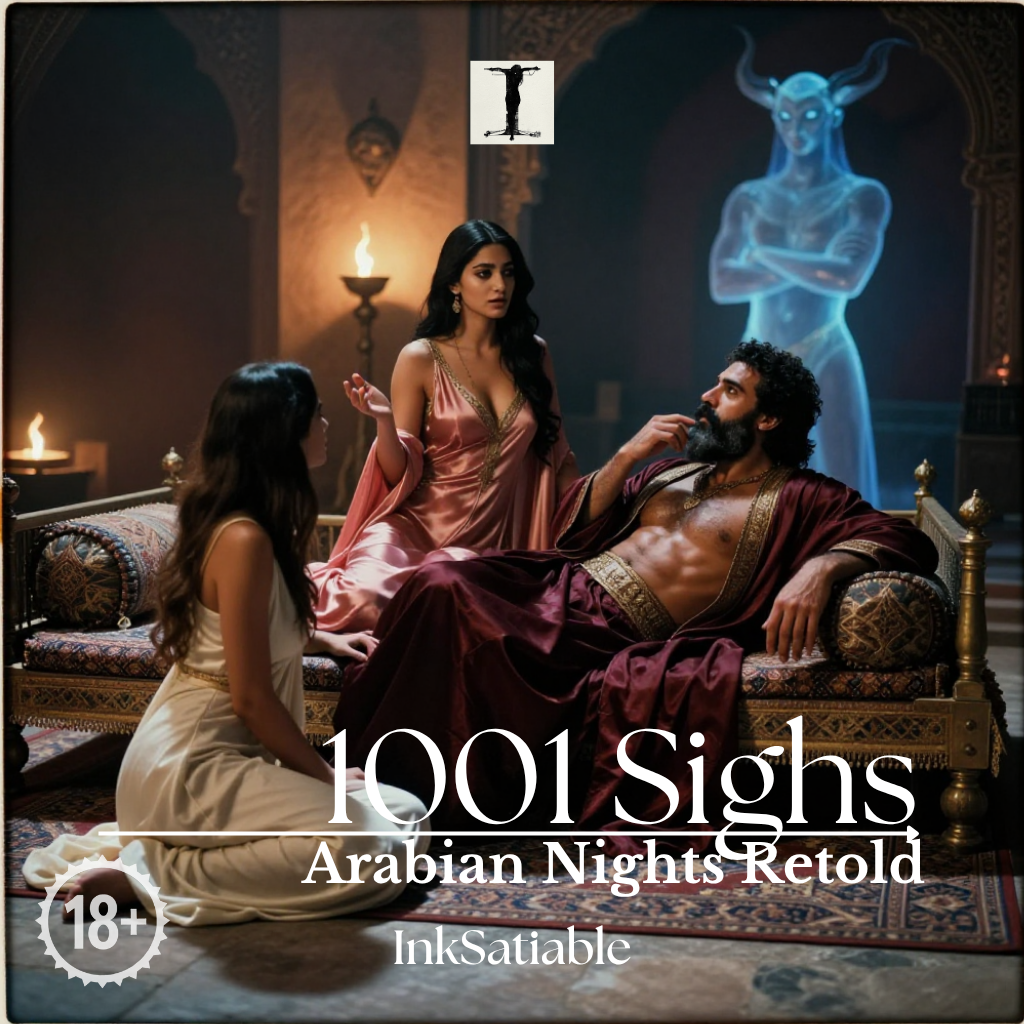
This book is that experiment. A Thousand and One Sighs amplifies the latent heat of the original tales, drawing out their implicit sensuality and moral complexity. It is a re-imagining, not a replacement—an attempt to honour the text’s audacity while weaving in the psychological depth and bodily frankness that modern readers expect. Here, the jinn’s brides are neither victims nor vixens, but women who wield desire as both weapon and birthright. The sultans’ cruelty is not merely a plot device, but a mirror for our own complicity in systems of power.
Yet this project comes with necessary reckonings. The Nights is a product of its time, rife with portrayals of women, slaves, and Black characters that range from reductive to grotesque by contemporary standards. To “remain true” to the original is to inherit these flaws alongside its brilliance. I have not sanitised these elements, but I have approached them with clear eyes—not as endorsements, but as artefacts of a worldview both foreign and foundational. Where the text diminishes, I have sought to complicate; where it silences, I have imagined voices. If this retelling unsettles, let it spark dialogue about who gets to tell stories, and why certain narratives endure.
Finally, this book is a tribute to the unknown storytellers who first spun these tales in market squares and caravanserais, and to the translators who smuggled them across languages and centuries. To Sir Richard Burton, whose unapologetically sensual 19th-century translation first shocked and thrilled the West; to Fatema Mernissi, who recentered Scheherazade as a feminist icon; to the oral poets, scribes, and scholars who kept these stories alive through conquest and censorship. If my version falters, let it at least gesture toward their genius.
The Nights endures because it is more than a story—it is a conversation. A king’s rage, a queen’s gamble, a thousand tales spun to outwit dawn. May this retelling add another thread to that eternal tapestry.
As always, these stories will be free to read to start with. As they evolve, expect them to become available to Followers and Subscribers only.
I have no timetable so episodes may follow quickly or not, as the mood takes me.
Like all of my works, 1001 Sighs is intended for a mature audience that is not easily offended and includes spicy concept art.
Write a comment ...